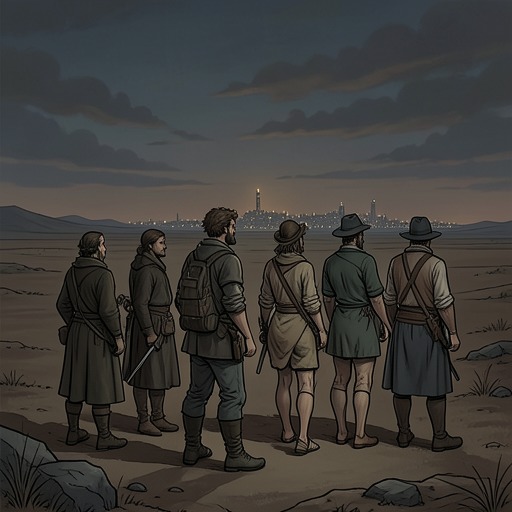
Descent to Earth
Good Morning, MidnightDescent to Earth brings Sully, Gordon Harper, and Tal out of orbit in the Soyuz reentry capsule, turning a return journey into a passage through fear, grief, and renewed attachment. The capsule’s arrival is not confirmed: the narrative ends with Sully preparing for impact. What it does confirm is her changed readiness to meet whatever waits below, and Harper’s declaration of closeness at the threshold of that unknown.
Departure and Descent
Tal releases the Soyuz reentry capsule from the docking port, ending one journey and beginning another. He first makes a short engine burn to move the capsule away from the station and onto a parallel orbit, then a longer burn that carries it around the planet and farther from the station. The capsule sinks toward the atmosphere at a sloping angle. Tal sheds the orbital module and instrument-panel components; bolts explode above and below the descent pod as the discarded sections spin away.
As the capsule enters denser atmosphere, plasma covers the window and the heat darkens it. Gravity builds from a gradual pull to a force that leaves Sully barely able to move. She worries that the long-unused Soyuz may fail: its heat shield might be faulty or its parachute might not open. Her fear is sharpened by how much she wants to survive and see what comes next. Without thinking, she reaches for Gordon Harper’s arm. He watches her and lays his gloved hand over hers.
From Terror to Readiness
The first parachute opens with a violent jerk, and the wind outside is deafening after the silence of space. The force of gravity makes it difficult for Sully even to nod. When the turbulence eases, the second parachute opens with a gentler tug, and the descent becomes smoother. The sequence does not remove the danger, but Sully’s response changes: as the sound of the wind abates, terror begins to leave her muscles. She is ready to survive, open the pod, and discover the world they are entering, though she has no way of knowing what condition that world is in.
Through the mostly blackened window she catches sight of a small piece of clear, blue sky. Even the possibility that the capsule might still fail cannot cancel the meaning of that glimpse. To Sully, the sky makes the journey worthwhile; she understands the place below as home before she knows what awaits on its surface. The scene connects the bodily ordeal of reentry to a more inward arrival: after isolation and loss, the prospect of an unknown Earth becomes something she is willing to face.
Names, Love, and the Unfinished Return
Gordon Harper remains focused on Sully as the capsule descends, and she realizes that she loves him more deeply than she had thought possible. His next words make the moment personal in another way: he calls her Iris, a name no one has used for her in a long time. She likes hearing it from him and tells him she is glad she came. The exchange joins the return to Earth with a recognition of intimacy and of a name that belongs to her beyond the familiar form Sully.
Sully closes her eyes and braces for impact, hoping she will have time to hear Harper say her name again. Her final reply affirms that she, too, is glad she came. The narrative stops at that suspended instant, before the capsule lands and before the survivors can learn what kind of world they have reached. Thus the return offers neither a confirmed rescue nor a settled homecoming; it ends with an open sky, a shared declaration, and Sully prepared to meet the impact.